Building a low-cost jaundice detection device for newborns in Uganda
89% RGBC Optical Sensing Accuracy<$75 Production CostCurrently IN USE at Kisenyi Health Centre IV
Presenting the neonatal jaundice workflow with Makerere collaborators.
I've always wanted to combine engineering with service, travel, and real-world problem solving.
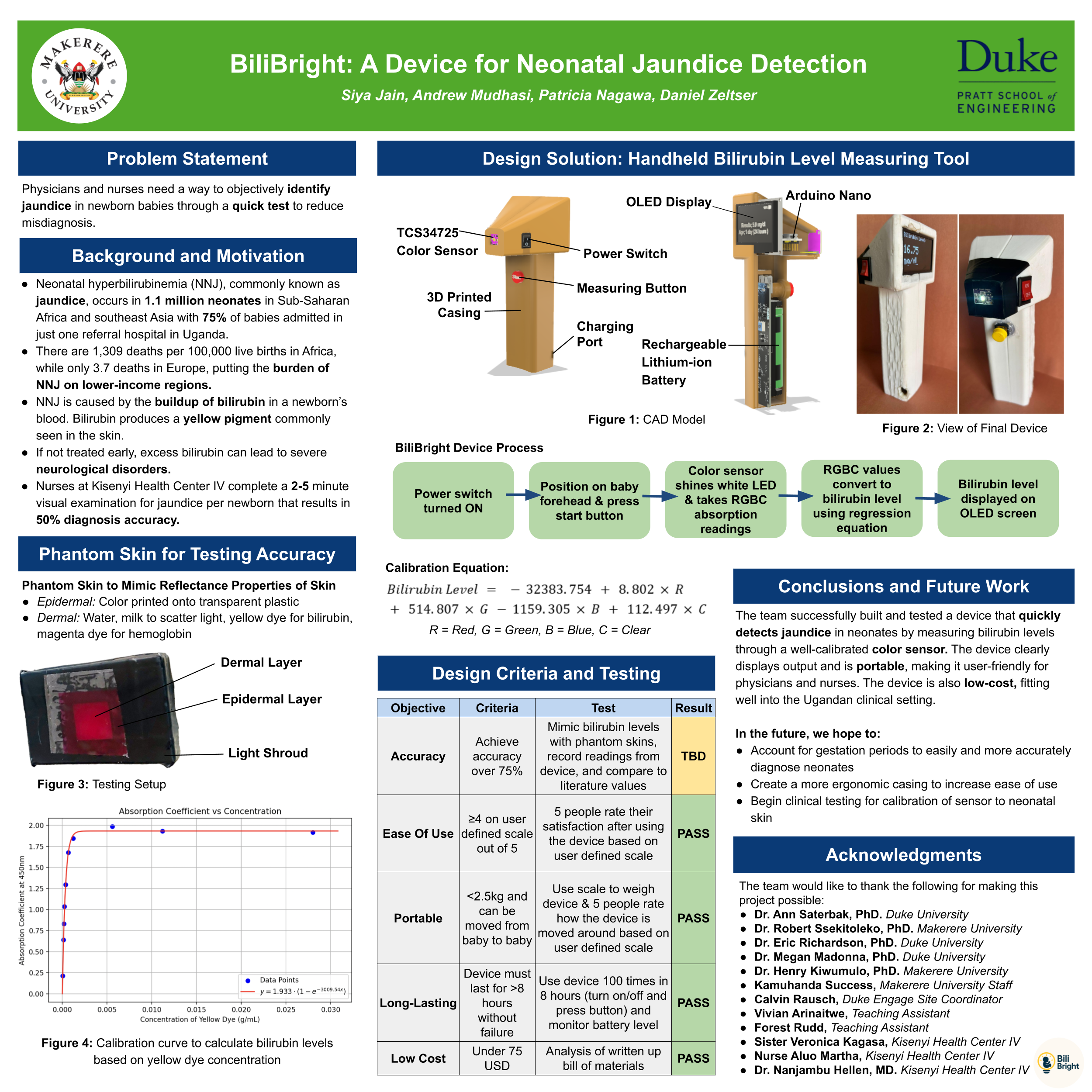
That led me to Uganda, where I worked with a team of brilliant students from Makerere University and Duke to build BiliBright, a handheld device for neonatal jaundice detection.
The problem was immediately clear.
In many low-resource settings, newborn jaundice is still diagnosed through visual examination, blood tests, or expensive bilirubinometers. Visual checks can miss cases, blood tests require lab infrastructure and waiting time, and traditional bilirubinometers can cost thousands of dollars.
So we built a low-cost alternative.
BiliBright uses an optical color sensor placed on a newborn's forehead to take RGBC absorption readings, then converts those values into bilirubin levels using a regression equation. The result is displayed directly on an OLED screen, making the device simple enough for frontline clinicians to use with minimal training.
We designed the device around the constraints of the environment it was meant for: low cost, portability, ease of use, long battery life, and locally available components.
Our prototype used a 3D-printed casing, Arduino Nano, TCS34725 color sensor, rechargeable lithium-ion battery, OLED display, power switch, and single measuring button.
We built and tested phantom skin models to calibrate the system, ran usability and durability tests, and designed the device to be moved from baby to baby in a clinical setting.
The project was recognized through the Africa Business Concept Challenge and later included in the Futurize incubator cohort.
After founding and building the project, I ultimately stepped away to focus on problems closer to home, especially the healthcare automation work that became Nectar.
Looking back, BiliBright taught me how different it is to build for real clinical constraints rather than ideal lab conditions. It also reinforced the kind of problems I'm most drawn to: overlooked healthcare workflows where engineering can make an immediate human impact.